

Bad Credit, Five Debts, One Plan: How Debt Consolidation Loans UK Really Work
Struggling with multiple debts? See how debt consolidation loans for bad credit in the UK from a direct lender can simplify repayments and rebuild your score.
 mslukasthomas99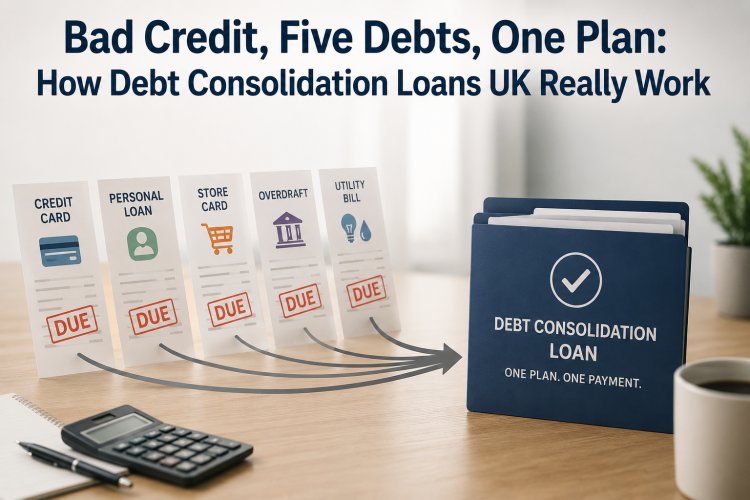
There is a particular kind of dread that arrives around the 28th of the month. You know the one. Three minimum payments have gone out, the overdraft fee has landed, and there is still a week until payday.
If your credit file took a knock somewhere along the way, you have probably assumed that consolidating those debts into one loan is off the table. It usually is not. But the version of consolidation available to you looks different from the glossy adverts, and you deserve to know how, before any application form gets filled in.
First, a quick reality check on the phrase 'bad credit'
Lenders do not see one big red stamp on your file. They see history: a missed phone bill in 2023, a defaulted card in 2024, and maybe a settled CCJ. Each item carries different weight, and that weight fades over time. And if you are facing a loan strike due to your poor credibility, then what to do? How to deal well?
The simple answer is to avail of debt consolidation loans for bad credit in the UK from a direct lender. These loans can support you to do better and optimise your finances.
In the UK, most negative markers drop off your credit report after six years. So a file that looks hopeless to you might read as 'recovering' to an underwriter, particularly one at a specialist direct lender whose entire business is built around customers the high street turned away.
That matters, because it means rejection from your bank is the start of the search, not the end of it.
Five myths that keep people stuck
Myth 1: Applying will wreck my score further. Only hard searches leave a footprint. Reputable lenders run a soft eligibility check first, which nobody else can see. Get your likely answer that way before committing to a full application.
Myth 2: Bad credit means guaranteed rejection. Since the FCA pushed lenders towards affordability-based decisions, your current income and outgoings often matter more than mistakes from three years back.
Myth 3: Consolidation reduces what I owe. It does not. It reorganises the debt. The benefit is in the interest rate, the single payment date, and the breathing space, not in any reduction of the balance itself.
Myth 4: All these loans need a guarantor. Some do. Plenty do not. Guarantor lending has actually shrunk in the UK market, and several direct lenders now assess applications on your own merits.
Myth 5: A debt charity and a lender will tell me the same thing. They will not, and that is healthy. Speak to both. StepChange or National Debtline will tell you honestly if a debt management plan suits you better than fresh borrowing.
What a direct lender actually checks
When you apply directly, rather than through a broker who farms your details out to a panel, the assessment happens in one place. Expect the lender to look at:
- Your income, and how stable it is month to month
- Regular outgoings, from rent and council tax through to subscriptions
- Your existing debts and the cost of servicing them
- What your file at Experian, Equifax or TransUnion shows, and how recent the problems are
- Whether the proposed repayment leaves your budget breathing, not gasping
Reputed direct lenders carry the risk on their own books, so the decision tends to be quicker and the criteria clearer. There is also a privacy upside: your data is not pinging around a dozen firms you never chose.
The honest Arithmetic
Picture a fairly typical tangle: 4,500 pounds across two credit cards at roughly 32% APR, an 800-pound overdraft at 39.9%, and 700 pounds left on store finance. Call it 6,000 pounds, costing perhaps 215 pounds a month in minimums, with the balances barely moving.
Consolidate that 6,000 pounds at 26% APR over three years, and the repayment comes to about 241 pounds a month. Slightly more than before, yes. But the debt is gone in 36 months flat, instead of dragging on for a decade of minimum payments.
Stretch the same loan to five years, and the monthly drops to around 178 pounds, easier on the budget, though the total interest climbs by well over a thousand pounds. Neither version is wrong. They are different tools for different situations, and a decent lender will show you both before you choose.
Where it goes wrong, and how to make sure it does not
Consolidation has a failure mode, and it is worth naming plainly: the empty credit card.
You clear three cards with the loan. Six months later, a car repair or a tempting holiday lands on one of them. Now you are servicing the loan and a rebuilt card balance. This happens to a lot of people, and it is the single biggest reason consolidation gets a bad name.
Three habits protect you:
- close or freeze the cleared accounts, keeping at most one card with a small limit for emergencies
- set the loan repayment as a standing order for the day after payday, so the money never feels spendable
- build even a tiny emergency fund, since 300 pounds in savings prevents most of the borrowing relapses that 3,000 pounds of new credit causes
When should the answer be 'not a loan'?
If the sums above made your stomach drop because no realistic repayment fits your budget, more borrowing is not your answer, and any lender worth dealing with will say so to your face.
Free, regulated help is a phone call away:
- MoneyHelper, backed by the government, for impartial guidance on every debt option
- StepChange Debt Charity, for free advice and managed plans
- Citizens Advice, for support in person, by phone or online
- National Debtline, for confidential one-to-one help
Options like a DMP, an IVA, or, in some cases, a Debt Relief Order exist precisely for situations a loan cannot fix. Using them is not failure. It is arithmetic.
A short word on rebuilding
Here is the quiet upside nobody mentions. A consolidation loan, repaid on time every month, becomes a positive entry on your credit file, often the first one in years. Twelve months of clean payments can shift how every future lender reads you, from your mobile contract to, eventually, a mortgage in principle.
Bad credit is a chapter. It was never the whole book.
The takeaway
A debt consolidation loan for bad credit, taken from an authorised UK direct lender, will not perform miracles. What it offers is order: one payment, one rate, one finish line you can actually see.
Check the register. Run a soft search. Compare the total repayable, not the monthly headline. Talk to a free debt charity if anything feels tight. And if the numbers work, take the loan with the old accounts closed behind you, and do not look back.