
Humans Head Back to the Moon After 50 Years: Artemis II Mission Begins Historic Journey
In a major milestone for space exploration, NASA has launched its historic Artemis II mission toward the Moon
 prativad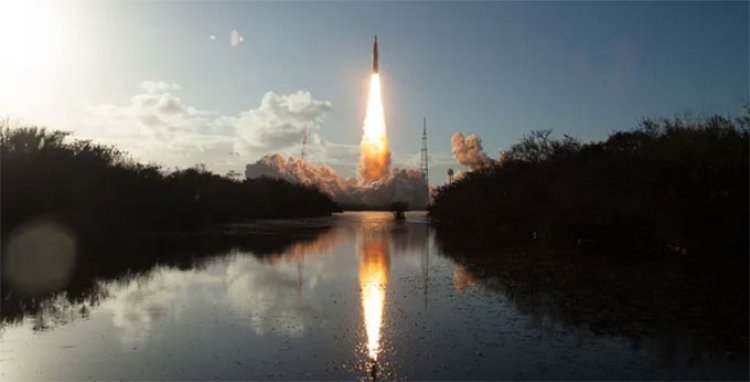
In a major milestone for space exploration, NASA has launched its historic Artemis II mission toward the Moon, marking humanity’s return to deep space after more than five decades. This is the first crewed mission to leave Earth’s orbit since Apollo 17 in 1972.
The mission successfully completed its critical Trans-Lunar Injection (TLI) burn, propelling the spacecraft out of Earth’s orbit and onto a trajectory toward the Moon. The crew is traveling aboard the Orion spacecraft, designed for long-duration missions beyond low Earth orbit.
The four-member crew includes Commander Reid Wiseman, along with Victor Glover, Christina Koch, and Jeremy Hansen. The mission is also notable for its diversity, featuring the first woman and the first Black astronaut assigned to a lunar mission.
Spanning approximately 10 days, Artemis II will not land on the Moon but will perform a close flyby, allowing astronauts to collect critical data and capture images. The spacecraft is expected to reach the Moon in about four days, including a pass around the far side—an area not directly visible from Earth.
This mission serves as a crucial test for future lunar landings, particularly the planned Artemis III, which aims to return humans to the lunar surface. It is a key step toward establishing a sustained human presence on the Moon.
Experts say the Artemis program is not just about science, but also about strategic positioning in the new space race. As nations push to expand their presence beyond Earth, missions like Artemis II could shape the future of space exploration and resource utilization.
If successful, Artemis II will mark the beginning of a new era in human spaceflight—bringing the dream of returning to the Moon closer to reality.