
Why Scenario Testing Catches What Every Other Test Layer Misses
 marcuskeenton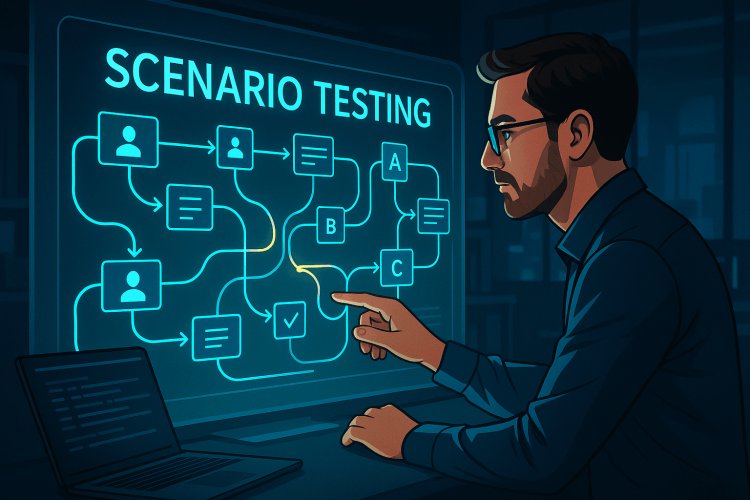
Unit tests verify that individual functions work. Integration tests verify that components communicate correctly. End-to-end tests verify that the full stack holds together for a specific flow. Each of these layers has a clear scope and a clear category of bugs it's designed to catch. Scenario testing sits across all of these layers but focuses on something different: not whether individual pieces work, but whether a complete user journey through the system produces the right outcome.
The distinction sounds subtle. In practice, a codebase can pass every unit test, every integration test, and a set of end-to-end tests for specific flows and still fail a scenario test that follows a user through a sequence of interactions that no single test thought to cover. That gap is where real-world bugs live.
What Scenario Testing Is Actually Covering
A scenario represents a coherent narrative of user behavior. Not "the login endpoint returns 200" but "a user registers, confirms their email, logs in from a mobile device, updates their profile, and then receives a notification based on that update." The individual steps might all work correctly in isolation. The scenario test verifies that they work correctly in sequence, with state accumulated from each step carried forward to the next.
This is important because systems that look correct at the component level often exhibit emergent behavior at the scenario level. A user object created in one flow may be in a slightly different state than expected by a subsequent flow. A background job triggered by one action may interfere with a concurrent action in a way that only becomes visible when both happen together. An edge case in how state transitions are handled becomes visible only when a specific sequence of transitions occurs.
Scenario tests expose these interactions because they exercise the system the way users actually exercise it, in sequences, with accumulated state, under conditions that emerge from prior actions rather than from a freshly initialized test fixture.
Designing Scenarios That Actually Test Something
The risk in scenario testing is writing scenarios that are long and complex but don't test anything more than the individual steps in sequence. A scenario that follows the happy path from start to finish, with no variation, with all inputs valid, verifies that the nominal case works. That's valuable but it's a fraction of what scenario testing can cover.
Useful scenario design starts from user behavior patterns, not from system architecture. What are the actual journeys that real users take through the product? Which of those journeys have caused problems before? Which of them involve state that needs to be consistent across multiple steps? Which of them involve concurrent actions that could interfere with each other?
The scenarios worth writing in detail are the ones that trace complex journeys, involve state that accumulates across steps, or exercise paths where things have gone wrong historically. The simple happy path scenarios are worth having, but they're the floor rather than the ceiling.
Where Scenario Testing Fits in the Stack
Scenario testing isn't a replacement for any of the other testing layers. It's additive, and it works best when the layers beneath it are solid. If unit tests are missing and basic component behavior is unreliable, scenario tests will fail for reasons that obscure the actual issue. The debugging process for a failing scenario test is inherently harder than for a failing unit test because there are more moving parts.
The right place to invest in scenario testing is after the lower layers are stable and the question has shifted from "do the components work" to "does the system do what users need." At that point, scenario coverage addresses a category of risk that no amount of additional unit testing will close.
Keploy's traffic capture approach pairs naturally with scenario testing thinking, because real user sessions are themselves scenarios. When traffic from a real user journey gets captured and replayed as a test, the test is inherently scenario-shaped: a sequence of related requests, with state carried between them, testing real behavior rather than predicted behavior.