
Madhya Pradesh Unveils Roadmap to Cut Major Non-CO₂ Pollutants
New state-wide study conducting satellite-based spatial analysis finds that emissions in the state are not evenly spread but divided into
 prativad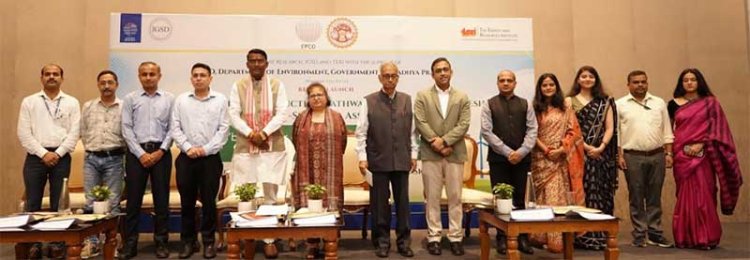
New state-wide study conducting satellite-based spatial analysis finds that emissions in the state are not evenly spread but divided into four distinct regions with different dominant sources; recommended pathway could cut SO₂ by 80%, NOx by 78% and black carbon by 56% by 2047 against business-as-usual
Bhopal, September 7, 2026: Madhya Pradesh today unveiled a first-of-its-kind, state-wide assessment of non-CO₂ pollutants that maps where emissions are coming from and identifies different strategies for key sectors, across different parts of the state.
The report titled, Non-CO₂ Emission Reduction Pathways for Madhya Pradesh: A Multi-Sectoral Assessment, finds that Madhya Pradesh does not have a uniform regional emissions profile. Satellite-based analysis identifies four distinct pollution regions, with industry and transport emerging as important sources in Indore, Bhopal, Gwalior and Jabalpur; coal-mining methane concentrated in Singrauli; and livestock methane particularly significant in districts including Sagar, Morena, Rewa, Khargone and Chhindwara.
The report was launched by Shri Dileep Ahirwar, Minister of State, Department of Forest and Environment, Government of Madhya Pradesh, on the International Day of Clean Air for Blue Skies, in tandem with this year’s theme ‘Clean Air for Climate Action’. It has been developed by the Environmental Planning & Coordination Organisation (EPCO), Department of Environment, Government of Madhya Pradesh, in partnership with the Institute for Governance & Sustainable Development (IGSD), Gateway Research and The Energy and Resources Institute (TERI).
Built on a 12km x12 km gridded, activity-based emissions inventory for 2019 and an independent satellite-based spatial analysis, the study examines emissions across sectors such as transport, industry and mining, power, waste, agriculture and livestock, and residential cooking. It then models their trajectories to 2030, 2040 and 2047 and assesses alternate policy pathways for reducing them.
Shri Dilip Ahirwar, Minister of State, Department of Forest and Environment, Government of Madhya Pradesh, said: “Assessments like these are critical because they indicate the micro-challenges we face today and also delve into macro-economic issues. They help us to anchor our environmental planning as well as evidence-led empirical data analysis. These district-level data analyses give us precise information on the sources of our pollution and the risks we face today.
For instance, we see that open burning of agriculture residue is a major driver of PM2.5 and PM10, and also black carbon emissions. The report indicates hotspots of pollution in MP as well which will help to take more informed policy decisions.
What makes this report particularly important is the way it doesn’t stop at framing the challenges only. It offers clear, actionable solutions that can support policy effectively. The recommendations – like an emphasis on time-bound, sector-specific roadmaps for high-impact areas like mining, transport, and industry; leveraging existing national schemes like SATAT, PMUY, and AMRUT while tapping into climate finance and CSR funds to finance low-carbon infrastructure – are clear and align with the trajectory of forward-looking state policies.
The report does a very commendable job of bridging the gap between scientific research and executive action. This is always invaluable since it results in policy interventions which protect public health while sustaining economic growth.”
Madhya Pradesh faces growing exposure to both heat and air pollution. By the mid-century, average maximum temperatures in the state are projected to rise by 1.3–1.6°C and minimum temperatures by 1.4–1.8°C as compared to 1981-2010 baseline levels. The eastern half of the state is projected to warm fastest, while districts including Dindori, Bhind and Sidhi are particularly vulnerable because of their lower adaptive capacity.
The report argues that reducing carbon dioxide remains essential, but that faster action on short-lived climate pollutants such as methane and black carbon can complement long-term decarbonisation by reducing near-term warming while also improving air quality and public health.
One of its most significant findings concerns methane. The study finds methane to be Madhya Pradesh's highest emitted pollutant after CO₂, with livestock accounting for around 60%, or 843 kilotonnes a year, of methane emissions in 2019. Natural farming practices could reduce methane from rice cultivation by up to 65%, while better fodder management and balanced cattle feeding could deliver livestock methane reductions of 10–15% relatively quickly and at low cost.
The study also identifies major opportunities in power and transport. Together, the two sectors accounted for 92% of Madhya Pradesh's NOx emissions in 2019. Under business-as-usual, power-sector NOx emissions could nearly quadruple by 2047. The study finds that a combination of renewable-energy expansion and partial gas substitution could reduce power-sector NOx by as much as 91% against that trajectory.
Across sectors, combining the most effective regionally adapted interventions into the report's recommended pathway could, by 2047, reduce SO₂ by approximately 80%, NOx by 78%, NMVOCs by 61% and black carbon by 56% compared with business-as-usual. The reductions would be driven substantially by renewable-energy expansion and gas substitution in power, cleaner industrial fuels, and greater EV adoption and vehicle scrappage in transport.
Shri Harshal Pancholi, IAS, Executive Director, EPCO, said: “Policy is only as good as the evidence behind it. What makes this study useful is that it combines a high-resolution emissions inventory with spatial analysis and then takes the next step of asking what different policy choices could achieve. It gives us a practical decision-support tool: where emissions are concentrated, which sectors need priority and where existing policies can be strengthened. This can help us align action across departments and sharpen the next phase of Madhya Pradesh's climate and clean-air planning.”
The report also points to relatively immediate opportunities. Open burning of agricultural residue accounted for 47% of black carbon emissions in 2019, according to the assessment; enforcing the existing burning ban by 2030 is modelled to eliminate this source. In homes, meanwhile, biomass-based cooking makes the residential sector the largest source of NMVOCs. Greater use of solar cookstoves, biogas and LPG could reduce residential NMVOC emissions by around 80% and black carbon emissions by close to 100% by 2047.
Zerin Osho, President, Gateway Research and Director, IGSD India, said: “The numbers tell us why action on these pollutants cannot wait for the end of the decarbonisation journey. Madhya Pradesh's livestock sector alone accounted for around 60% of the state's methane emissions in 2019, while agricultural residue burning accounted for nearly half of black carbon emissions. These are also areas where solutions already exist. Natural farming can cut methane from rice cultivation by up to 65%, and better cattle feeding can begin reducing livestock methane relatively quickly. CO₂ reduction is the marathon we have to keep running, but cutting methane, black carbon and other short-lived pollutants is the sprint that can deliver cleaner air and slow warming in the near term. Madhya Pradesh now has the evidence to do both.”
Madhya Pradesh already has a substantial base on which to build. The state leads India in organic farming, with 0.76 million hectares, or 27% of the country's organic cultivation area. As of 2023, it had developed 3,022 MW of solar generation capacity, while Indore became the first Indian civic body to earn revenue through carbon-credit trading. The State Action Plan on Climate Change, Madhya Pradesh EV Policy 2025 and Renewable Energy Policy 2025 provide an institutional framework for further action.
The report recommends time-bound sectoral roadmaps, particularly for mining, transport and industry, and targeted action on livestock, agriculture and coal mining, which it identifies as some of Madhya Pradesh's largest untapped opportunities for reducing non-CO₂ emissions. It also calls for greater use of existing national programmes and climate and CSR finance to scale clean infrastructure, alongside stronger monitoring through real-time emissions tracking and remote sensing.